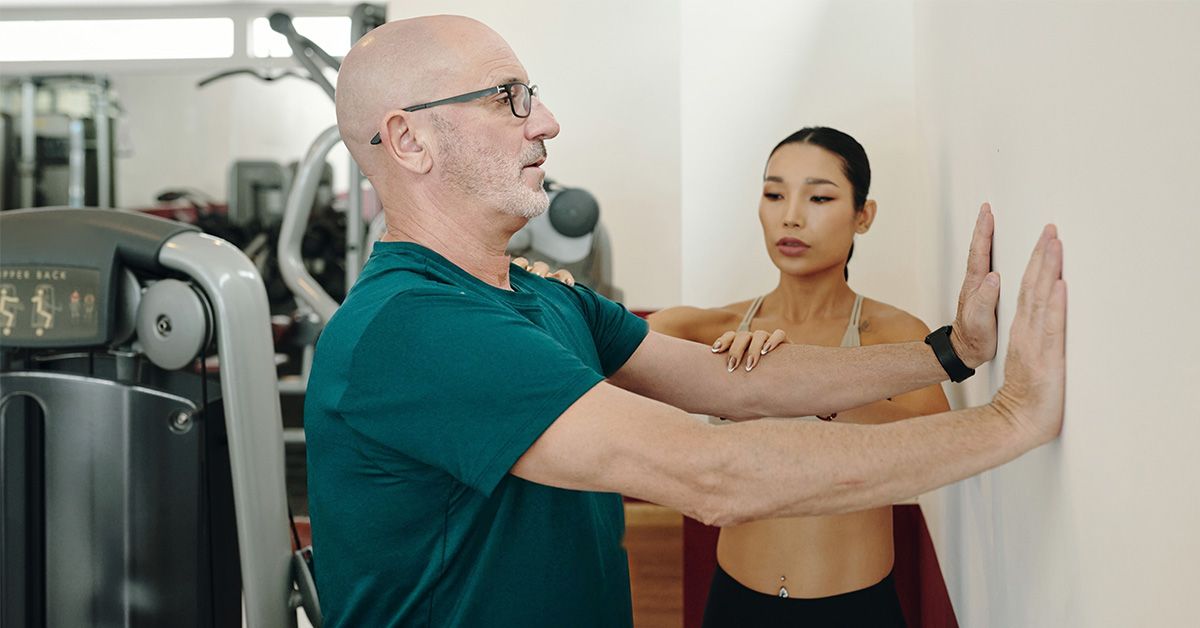
on PinterestEccentric exercise may help build muscle strength with less strain on the body, which may benefit older individuals.
on PinterestEccentric exercise may help build muscle strength with less strain on the body, which may benefit older individuals. DragonImages/Getty Images
- A lesser-known type of exercise can build strength and improve fitness while remaining accessible to less active individuals.
- Eccentric exercises like lowering weights or walking downhill can generate more force with less energy while supporting muscle, heart, and even brain health.
- Whether you’re an advanced athlete or just beginning, eccentric exercise can offer unique benefits to your training regimen.
When people think about exercise or weight training, they tend to focus on concentric exercises: those powerful movements that shorten muscles, like curling a dumbbell or powering upward in a squat.
Concentric exercise is a well-established way to build muscle and improve fitness, but eccentric exercise, the portion of a movement that lengthens the muscle, may offer additional benefits.
Eccentric training, an often-overlooked form of exercise, can help build strength with less perceived effort.
Eccentric exercise may help build muscle strength with less strain on the body, according to an article recently published in the Journal of Sport and Health Science. It may also offer specific advantages over concentric exercise for muscle rehabilitation and even brain health.
These benefits may be particularly meaningful for certain groups. For older adults and those who are less physically active, eccentric exercise may provide an accessible, low impact form of training that can improve fitness.
Study author Kazunori (Ken) Nosaka, PhD, director of Exercise and Sports Science at Edith Cowan University in Western Australia, said he aims to help normalize eccentric exercise.
“Every eccentric contraction counts. People may be discouraged by thinking they have to do lots of exercise to get fitter and healthier. But people can do a small amount of these exercises and still benefit,” Nosaka told Healthline.
What is eccentric exercise?
Muscles have three fundamental types of contraction:
- Concentric — muscle shortening, such as lifting a dumbbell.
- Eccentric — muscle lengthening, such as lowering a dumbbell.
- Isometric — a static muscle contraction without a change in length, such as holding a plank.
In physiology and exercise science, eccentric contractions were not well understood until the mid-20th century.
“The word eccentric literally means something that’s odd or peculiar. This type of contraction was given that term because for a long time, scientists weren’t able to explain it. How muscle produces force while it is being lengthened was a big question mark,” said Lindsey Lepley, PhD, associate professor of athletic training, director of the Comparative Orthopaedic Rehabilitation Laboratory (CORL), and co-director of the Orthopedic Rehabilitation & Biomechanics Laboratory (ORB) at the what puzzled scientists was how a muscle could generate force while being stretched.
The concept of a concentric contraction feels intuitive because the muscle is visibly doing the work. However, research into muscle biomechanics has shown that muscles can also produce substantial force during eccentric movements.
Even more unintuitive, muscles may be capable of generating significantly more force — more than 20%, according to Nosaka — than during concentric or isometric contractions, while requiring less metabolic energy.
Benefits and risks of
Learn more about hair transplant at Rubenhair clinic.
Get a Free Consultation
Consult with our specialists about FUE procedure, PRP therapy or hair transplant.